
Last Updated: October 23, 2026
Quick Summary
Waterproof rock lights are generally safe for car washes if they carry a real water-resistance rating and were installed correctly. Touchless washes are safe for rated lights, brush washes are riskier, and high-pressure washing is safe if you keep your distance and aim away from seals.
- IP67 means dust-tight and protected against temporary immersion, but it is a floor, not a ceiling.
- Keep the pressure washer nozzle at least 12 inches away and spray at an angle, never straight-on.
- Brush washes risk snagging wires, displacing pods, abrasion, and bending loads on seals.
- Most water damage happens at wiring and connectors, so use dielectric grease and drip loops.
- Check pods for cracks and confirm connectors are dry before and after every wash.
Table of Contents
- Waterproof Rock Lights and Car Washes: The Short Answer
- What Waterproof Actually Means: IP67 Rock Lights Explained
- Rock Lights and the Automatic Car Wash: Touchless vs. Brush
- Pressure Washing Rock Lights: Safe Distance and Spray Direction
- Rock Light Wiring and Connectors: Where Water Gets In
- Pre-Wash and Post-Wash Checklist for Rock Lights
- Warranty Limits, Failure Symptoms, and When to Inspect
- Conclusion
- Frequently Asked Questions
Waterproof Rock Lights and Car Washes: The Short Answer
Yes, waterproof rock lights are generally safe for car washes, provided they carry a real water-resistance rating and were installed correctly. At GLOWGANG LIGHTING, we get this question a lot, and the honest answer depends less on the lights themselves and more on the type of wash and how the wiring was sealed.
Here's the quick version:
- Touchless car washes: Safe for rated lights. No physical contact, just water and soap.
- Brush car washes: Riskier. Brushes can snag loose wires or knock a pod out of alignment.
- High-pressure washing: Safe if you keep your distance and aim away from seals.
The 5 checks below cover ratings, wash types, spray habits, wiring, and a simple wash-day routine. Get those right and your rock lights will handle the car wash fine.
What Waterproof Actually Means: IP67 Rock Lights Explained
An IP rating has two digits, and each one answers a different question. The first digit covers solids (dust and grit); the second covers liquids. IP67 means the housing is dust-tight (6) and protected against temporary immersion in water (7) under defined test conditions.
That last distinction is the one that matters for a car wash. The immersion test behind the "7" places a light in still water at a set depth for a set time. A wash bay does the opposite: it hits the housing with moving, pressurized water from changing angles. Still water pushes evenly on a seal.
Here is what the rating does and does not tell you:
- It does confirm the housing was sealed to a published standard when it left the factory.
- It does not confirm the seal is still intact after installation, rock strikes, or a cracked lens.
- It does not set a maximum spray pressure, nozzle distance, or water temperature.
- It does not cover the connector, the splice, or the wire loom, those are separate components with their own sealing.
- It does not promise resistance to the soaps, degreasers, and wax additives used in wash bays, which can degrade some seal materials over time.
A practical way to read it: IP67 is a floor, not a ceiling. It tells you the light was designed to keep water out. It does not tell you the light is car-wash-proof, because no IP rating is written around a pressure wand held a foot from the lens.
If you want a light built to this spec, our GLOWGANG 24 LED HIGH INTENSITY PURE WHITE ROCK LIGHT POD is a sealed pod with a lifetime warranty, and it is the one we point most people to first.

Rock Lights and the Automatic Car Wash: Touchless vs. Brush
The wash type changes the physics your lights face, so treat the two systems as separate cases.
Touchless washes rely on water pressure, soap chemistry, and air dryers. Nothing contacts the vehicle, so the only stress on a rock light is spray, detergent, and heat. That is the environment an IP-rated pod is designed around.
Brush washes add spinning bristles, cloth strips, or foam rollers that physically drag across the body and the underside. That contact introduces failure modes water alone cannot cause:
- Snagging: a wire loop that hangs below its mount can catch a bristle and get pulled until the connector separates or the conductor breaks inside the insulation. The light may still look fine while the circuit is compromised.
- Displacement: a brush can push a pod off its bracket or rotate it out of aim. A pod held by a single bolt or a clamp is more vulnerable than one bolted through a solid mount.
- Abrasion: grit trapped in bristles acts like sandpaper on a polycarbonate lens, dulling output over repeated washes.
- Bending loads: the brush pushes sideways on the housing, which works the seal and the wire exit, the two spots most likely to admit water.
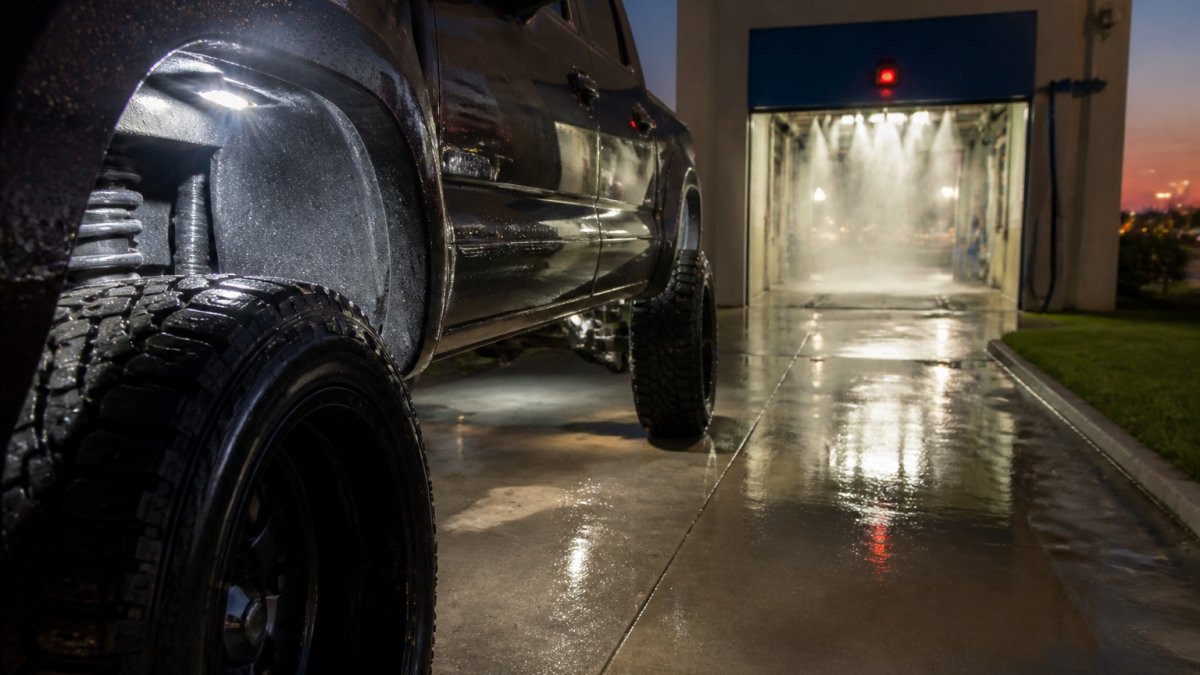
How to lower the brush-wash risk without skipping washes:
- Mount pods so no part of the housing or wiring hangs below the lowest protected surface.
- Route wires up and behind a panel, with a drip loop, so nothing dangles into the brush path.
- Use locking connectors or a positive latch, and confirm each one is fully seated before washing.
- Prefer through-bolted mounts over clamps that can slip under side load.
- If a pod sits in a spot the brush will clearly strike, remove it or skip the brush wash for that vehicle.
A reasonable rule: touchless is the default for any vehicle with underbody lights; brush washes are workable only when the install is tight, tucked, and inspected. If you are unsure how your lights are mounted, the touchless bay is the lower-risk choice.
The two automatic wash types put very different stress on your rock lights.
| Wash type | Contact with lights | Key risk |
|---|---|---|
| Touchless | None, just spray, detergent, heat | Spray pressure and nozzle position |
| Brush | Spinning bristles, cloth strips, foam rollers | Snagging, displacement, abrasion, bending loads |
Pressure Washing Rock Lights: Safe Distance and Spray Direction
Pressure washing rock lights is safe if you respect two things: distance and direction. High-pressure water forced straight into a seal will eventually win.
Follow these habits:
- Keep the nozzle at least 12 inches away from any pod.
- Spray at an angle, never straight-on into a lens or wire exit.
- Aim away from connectors and grommets.
- Use a wider fan tip, not a pinpoint jet.
The goal is to rinse, not to blast. Most water intrusion comes from people holding the wand too close while trying to clean mud off a pod.
GLOWGANG 24 LED HIGH INTENSITY PURE WHITE ROCK LIGHT POD →
Rock Light Wiring and Connectors: Where Water Gets In
Wiring and connectors are where most water damage actually happens, not the lights. A sealed housing means nothing if the plug behind it fills with water.
Here's where to focus:
- Plug-and-play connectors: Make sure they click fully and sit dry.
- Dielectric grease: A small amount in each connector blocks moisture.
- Wire loom: Wrap exposed runs to guard against spray and debris.
- High-temperature tape: Seal splices near hot or wet areas.
- Drip loops: Let wires dip before they rise, so water runs off instead of in.
A common mistake is leaving a connector hanging low where road spray collects. Route it up and tuck it behind a panel.
If you want a kit that comes with its wiring and connectors sorted, our GLOWGANG 30 LED MAX SERIES RGBW ROCK LIGHT PODS ship with all wiring and mounting hardware included, so there's less to seal yourself.

Pre-Wash and Post-Wash Checklist for Rock Lights
A two-minute routine before and after each wash prevents most failures. Run through this every time.
Before the wash:
- Check each pod for cracks or loose mounts
- Confirm connectors are clicked in and dry
- Look for frayed wire or worn loom
- Note any pod that looks dimmer than the rest
After the wash:
- Dry the pods and connectors with a microfiber cloth
- Check for water beads trapped around seals
- Power on and confirm all lights work
- Re-grease connectors if they look dry
This is also the moment to spot moisture before it turns into corrosion. A quick inspection beats a dead light later.
If you want a full setup you can maintain through wash cycles, our GLOWGANG 48 LED HIGH INTENSITY PURE WHITE ROCK LIGHT KIT is a plug-and-play kit with remotes and a controller, built for exactly this kind of regular care.

Warranty Limits, Failure Symptoms, and When to Inspect
Warranty coverage usually protects against defects, not water damage from a cracked lens or a bad install. Read the fine print before you assume a wash-related failure is covered.
Watch for these failure symptoms:
- Flickering: Often moisture in a connector.
- Dim output: Corrosion or water inside the housing.
- Dead pod: A failed seal or a broken wire.
- Condensation inside the lens: A clear sign water got past the seal.
Inspect right away if you spot any of these. Catching moisture early is the difference between drying a connector and replacing a pod.
Conclusion
Keeping rock lights safe through car washes comes down to three habits: know your rating, match your wash type, and inspect your wiring. Do those and your lights will survive the wash bay without drama.
At GLOWGANG LIGHTING, we build sealed, plug-and-play rock lights with lifetime warranty backing so you spend less time worrying about water and more time enjoying your setup. Browse our waterproof rock light pods and kits, and get the right gear for wash-day confidence.
Frequently Asked Questions
Can rock lights go through an automatic car wash?
It depends on the wash type. A touchless automatic wash that uses high-pressure water and no physical contact is the lower-risk option, provided your rock lights are properly sealed and wired. Brush-style washes are riskier: spinning brushes and cloth strips can snag wiring, pull at mounting hardware, and crack polycarbonate lenses. If you are unsure about your setup, skip the automatic wash and hand-wash instead. Waterproof rock lights with sealed housings and plug-and-play connectors handle spray far better than exposed wiring and open connectors.
What IP rating should rock lights have to withstand a car wash?
Look for IP67 rock lights at minimum. The second digit is the water rating: 7 means the housing survives temporary immersion in roughly 1 meter of water for about 30 minutes. That covers rain, puddle spray, and most wash water. IP68 adds longer or deeper immersion. Keep in mind the IP rating applies to the light housing itself, not your connectors or wiring. A sealed pod wired through an exposed connector can still fail, so protect every connection with a wire loom and dielectric grease.
Should I turn off rock lights before washing my vehicle?
Yes. Turn them off and let them cool before any wash. Hot LEDs hitting cold water can stress seals and lenses over time. Keeping them off also means you can spot water intrusion or flickering during the wash instead of masking it. After washing, dry the pods and connectors, then power them on and check for consistent output. If a pod flickers or looks dim, water may have reached the wiring. Inspect before your next wash rather than ignoring it.
Can high-pressure water damage rock lights or their wiring?
It can if you aim it directly at seals, connectors, or wiring. Pressure washing rock lights from about 12 to 18 inches away at a wide fan setting is generally fine. Never hold the nozzle inches from a pod or spray upward into a connector. High-pressure water forced past a seal causes water intrusion, and trapped moisture leads to corrosion in the wiring. After a pressure wash, dry the connectors and check that every pod still lights evenly.